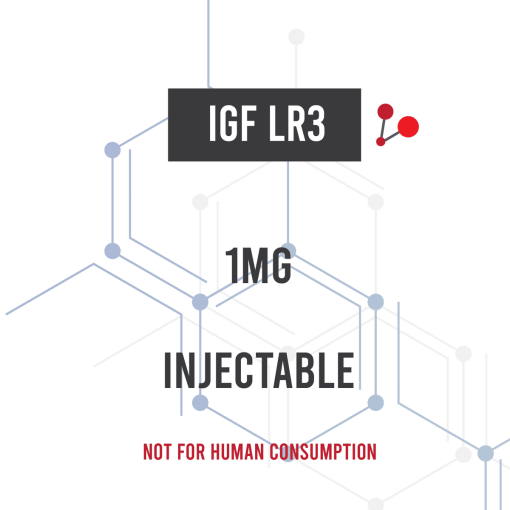

IGF-LR3 1MG
Description
IGF-1 Long R3 (commonly referred to as IGF-LR3 or IGF-1 LR3) is a modified analog of insulin-like growth factor-1 (IGF-1), designed for extended biological activity and reduced binding to IGF-binding proteins. A “1MG” designation typically refers to the total quantity of lyophilized peptide in a research vial, rather than an approved or standardized clinical dosing format.
IGF-1 LR3 is a synthetic variant of the naturally occurring hormone IGF-1, which plays a central role in growth, development, and tissue repair. The “Long R3” modification involves amino acid substitutions that increase the peptide’s half-life and enhance its bioavailability in experimental models. This structural change allows it to remain active in circulation longer than endogenous IGF-1.
In biological systems, IGF-1 is primarily produced in response to growth hormone (GH) signaling and acts as a key mediator of anabolic and growth-related processes. It exerts its effects by binding to the IGF-1 receptor (IGF1R), which is widely expressed in muscle, bone, and various soft tissues. Activation of this receptor triggers intracellular signaling pathways such as PI3K-AKT and MAPK, which are involved in protein synthesis, cell growth, and cellular repair mechanisms.
IGF-LR3 is often studied in experimental contexts for its enhanced potency compared to native IGF-1. Due to its reduced affinity for IGF-binding proteins, a greater proportion of the peptide remains biologically active, allowing for more sustained receptor interaction in research settings. This property has made it a subject of interest in studies of muscle biology, regeneration, and metabolic signaling.
At the cellular level, IGF-1 LR3 influences processes such as amino acid uptake, glycogen synthesis, and satellite cell activation in skeletal muscle. Satellite cells are involved in muscle repair and regeneration, and IGF-1 signaling is known to play a role in their proliferation and differentiation in experimental models.
Despite its biological relevance, IGF-LR3 is not an approved therapeutic medication in human medicine. There are no established clinical dosing guidelines, and its long-term safety profile in humans has not been validated through large-scale controlled trials. Most available data come from laboratory studies, animal research, and mechanistic investigations of the IGF signaling pathway.
Because of this, IGF-1 LR3 is generally classified as a research-use-only compound in most jurisdictions. Its effects in humans outside controlled scientific environments are not well characterized, and its use is not part of standard medical treatment protocols.
In summary, IGF-LR3 1MG is a modified insulin-like growth factor analog studied for its prolonged activity and enhanced signaling through IGF-1 receptors. While it is widely referenced in experimental biology for its anabolic and regenerative signaling properties, it remains unapproved for clinical use with limited human safety data.
Be the first to review “IGF-LR3 1MG”
Related products
PEPTIDES
PEPTIDES
PEPTIDES
PEPTIDES

PEPTIDES

PEPTIDES
PEPTIDES
PEPTIDES
Reviews
There are no reviews yet.