
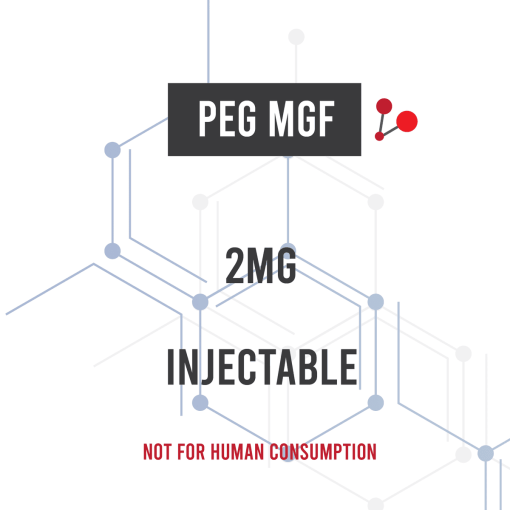

PEG-MGF 2MG
Description
Pegylated Mechano Growth Factor (commonly referred to as PEG-MGF) is a synthetic peptide derived from a splice variant of insulin-like growth factor-1 (IGF-1), known as Mechano Growth Factor (MGF). The “PEG” component refers to pegylation, a chemical modification that attaches polyethylene glycol chains to the peptide in order to increase its stability and extend its circulating half-life in experimental settings. A “2MG” designation typically refers to the total lyophilized peptide content per vial in research-use contexts.
PEG-MGF is primarily studied in non-clinical research environments for its potential role in tissue repair, muscle cell signaling, and localized growth factor activity. It is not an approved pharmaceutical medication and is not used in standard medical practice.
From a biological perspective, Mechano Growth Factor is produced as a result of mechanical stress or tissue damage, particularly in skeletal muscle. It is part of the broader IGF-1 signaling system, which plays a key role in regulating cell growth, differentiation, and repair. PEG-MGF is designed to mimic or extend the activity of this naturally occurring splice variant, allowing researchers to examine its potential effects on cellular regeneration pathways under controlled conditions.
In experimental models, PEG-MGF is often discussed in relation to satellite cell activation. Satellite cells are muscle-resident stem cells responsible for repair and regeneration following injury or intense physical activity. The IGF-1 pathway, including MGF-related signaling, is believed to contribute to the activation and proliferation of these cells, which has made PEG-MGF a subject of interest in muscle biology research.
Pegylation significantly alters the pharmacokinetic profile of the peptide. By attaching polyethylene glycol chains, the molecule becomes larger and more resistant to enzymatic degradation, which may increase its stability in circulation. This modification is commonly used in pharmaceutical research to extend the activity window of peptide-based compounds, although its effects on PEG-MGF specifically have not been fully characterized in human clinical trials.
Because PEG-MGF is not an approved therapeutic agent, there is limited clinical data regarding its safety, efficacy, or long-term biological impact in humans. Most available information is derived from laboratory studies, animal research, and theoretical extrapolations based on IGF-1 pathway biology. As a result, its physiological effects in real-world human use remain uncertain.
Potential areas of interest in research contexts include muscle tissue repair, recovery from injury, and localized anabolic signaling responses. However, these applications remain investigational and are not validated for clinical treatment or performance enhancement.
From a regulatory standpoint, PEG-MGF is generally classified as a research-use-only compound in most jurisdictions. It is not part of any approved medical treatment protocol, and standardized dosing guidelines for humans do not exist.
In summary, PEG-MGF 2MG is a synthetic, pegylated peptide derived from Mechano Growth Factor, studied primarily for its involvement in muscle regeneration pathways and IGF-1–related signaling. While it is frequently discussed in experimental biology, its clinical relevance remains unestablished due to a lack of controlled human research.
Be the first to review “PEG-MGF 2MG”
Related products

PEPTIDES
PEPTIDES

PEPTIDES
PEPTIDES
PEPTIDES

PEPTIDES

PEPTIDES

PEPTIDES
Reviews
There are no reviews yet.